
Oh wow this is a big one. When I agreed to host the ever-delectable Carnival of Mathematics from Aperiodical for the 4th time, I had no idea I would be tasked with showcasing the 250th edition of such a mainstay of mathematics communication. Wish me luck!
For any of you lucky readers that are discovering the Carnival for the first time, the idea is that each month a different mathematics blog, writes a blog, about interesting mathematics that has been blogged, by bloggers, and then highlighted by the mathematical community as an interesting blog.
Now that’s been cleared up, here is some interesting maths content published in March 2026.
We’ll start technical, because that is what we do here. This excellent post by Matthew Aldridge, submitted by Richard Elwes, makes the argument that the ‘multiset’ coefficient shouldn’t be an afterthought. Matthew takes us through a host of interesting properties of the multiset coefficient – and its relation to the binomial coefficient – before arriving at this astonishing result:
If you’re wondering what the multiset coefficent is (signified by the double bracket above), Matthew’s flag example is brilliant.
Why do we get this rising factorial when the order matters? I like to think of hanging k flags on n flagpoles:
- The first flag has n choices: it can go on any of the n flagpoles.
- The second flag now has n+1 choices: either it goes on one of the n-1 empty flagpoles, or it goes on the same pole as the first flag, in which case it can either go above the first flag or below it. Over all, that’s (n-1) + 2 = n+1 choices.
- The third flag has n+2 choices. If the first two flags went on different poles, we have n-2 empty flagpoles, above or below the first flag, and above or below the second flag, making (n-2) + 2 + 2 = n+2. If the first two flags went on the same pole, we have n-1 empty poles, or the busy pole: above both flags, in between them, or below both flags; that’s (n-1) + 3 = n+2 as well.
As we go, each flag creates an extra space, either by splitting an empty pole into “above or below the new flag”, or by splitting the “bit of pole” it gets attached to into directly above or directly below the new flag. Hence we get multisets where the order matters. Dividing by the k! orderings of the flags gives the expression we were after.
And for those of you wanting something even more mathematical that multiset coefficients, Brian M. Sutin and Skewray Research have you covered with an explanation of how to measure the ‘closeness’ of two stable distributions via a location parameter. Full details here.
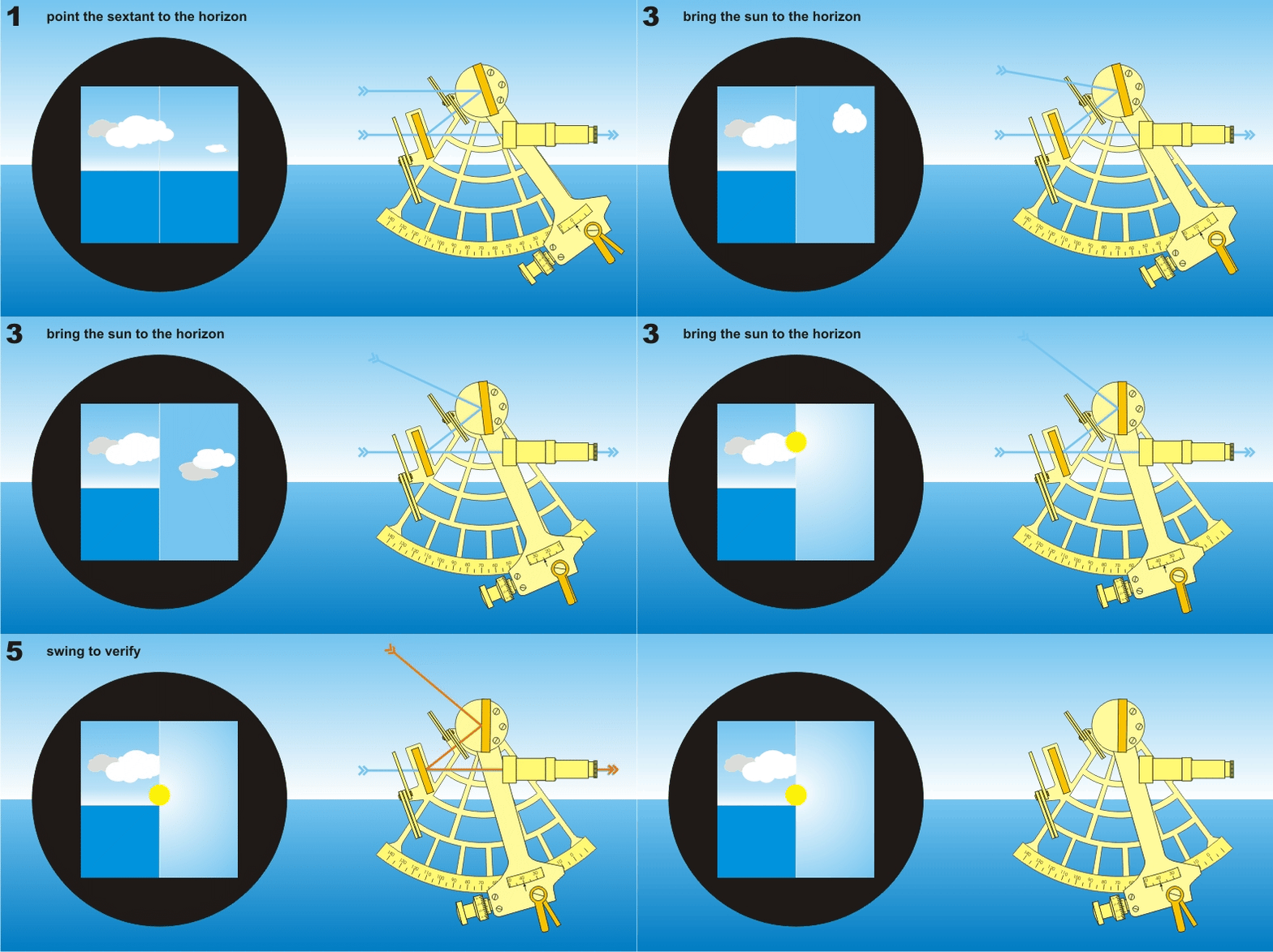
Next up, we have the resolution of the mystery of the infamous U+237C symbol, courtesy of Jonathan Chan. You can read the full post here, but the short version (without giving away too much) is that the “right arrow with downwards zigzag symbol” Unicode character is based on the way a light ray passes through a sextant to measure an azimuth. This Wikipedia image sums it up perfectly.
And now for a challenge. Set by none other than Terry Tao himself, and submitted by Club Joyous. The Mathematics Distillation Challenge, asks contestants to submit a “cheat sheet” that can increase the performance of AI models used to solve typical problems in universal algebra, such as:

The competition is open until April 20th and is open to anyone that registers here. Good luck!
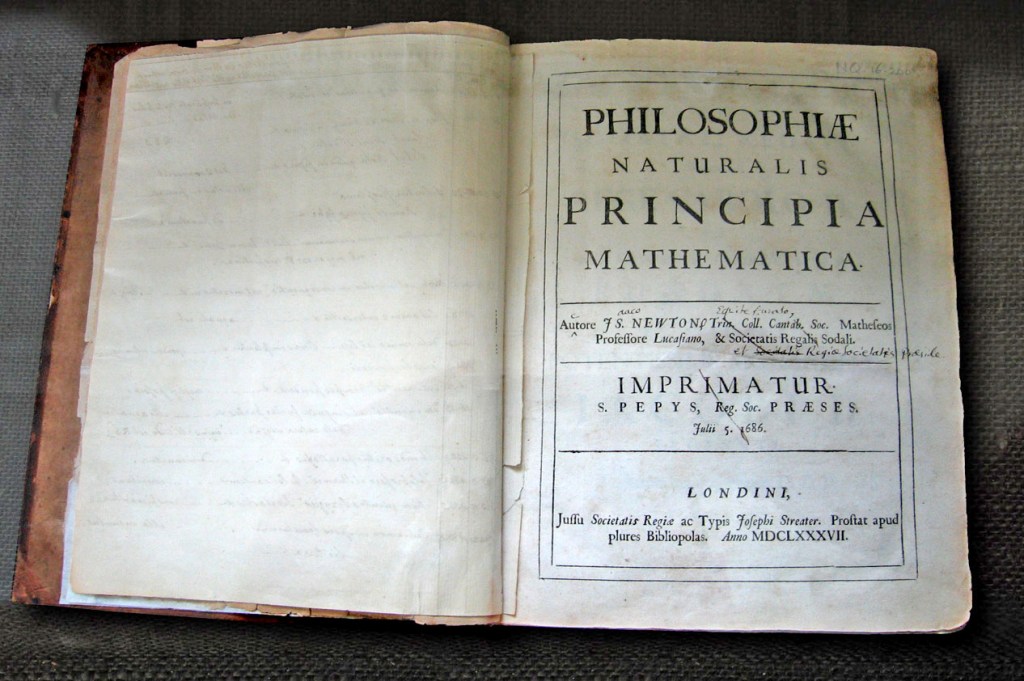
How about a little history? The next submissions comes from Robin Whitty who wished to highlight a recent blog post from ‘The Renaissance Mathematicus’ detailing the period of Newton’s life leading up to the publication of the Principia. It’s a fascinating story featuring names such as Hooke, Wren, Halley and De Movire – which you should go and read in its entirety here – but in the meantime, let’s all just bask in this photograph of the Principia with hand-written notes from the man himself. Beautiful.
Whilst we’re on the topic of history, let’s check-in with the curator of the history of science at the Smithsonian’s National Museum of American History, David E. Dunning, who explains to Quanta Magazine how choices of mathematical notation, whether Roman, Hindu or Arabic, change what you are able to do with mathematics. Find out more here.
It is no doubt fantastic to see maths being featured by the Museum of American History, but according to Davi Ottenheimer that may in fact be where American mathematics stays – confined to the history books. In his latest post on ‘The Flying Penguin’, which you can read here, Davi discusses the upcoming International Congress of Mathematics in Philadelphia, and asks why 1500 have signed a petition to boycott the event.
And now for something lighter, with the OG of maths shorts – Howie Hua – and an inventive way to calculate the sum of an infinite series with any random book.
Followed by a lovely introduction to i and imaginary numbers from PhD student Laura Walsh on her blog ‘Letters and Words’, which you can read here. Laura also hosted the Carnival of Mathematics -2 i2 before this one.
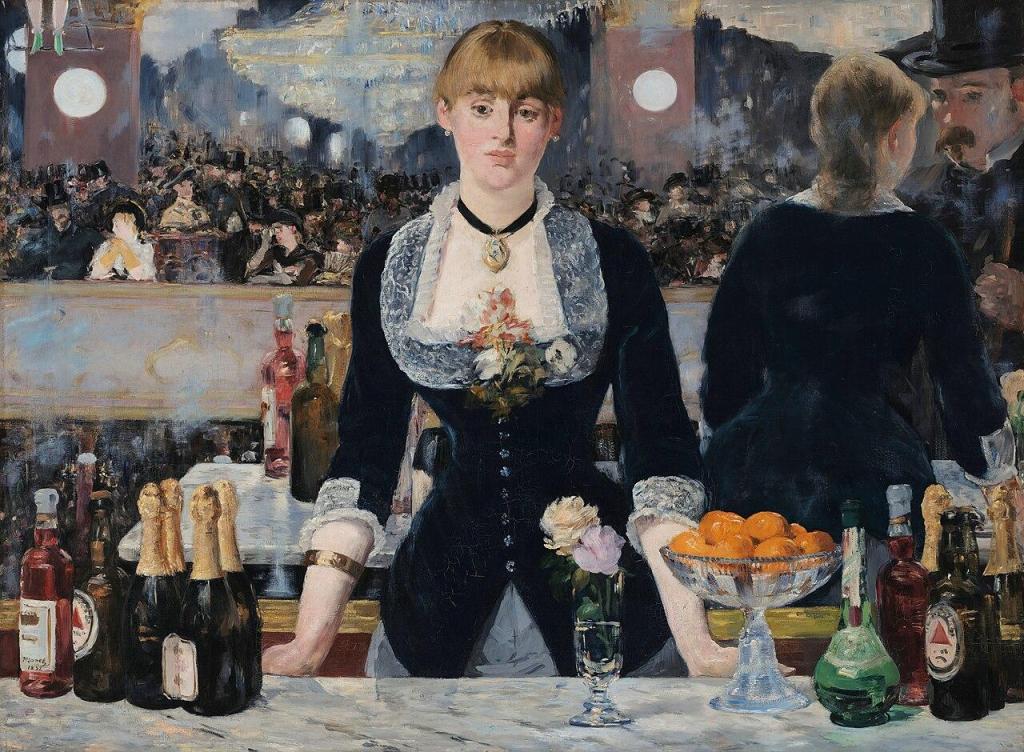
Now to art and John Carlos Baez on Mathstodon who shares the story of a researcher who showed the perspective of Manet’s famous painting “Un Bar aux Folies-Bergère” is indeed possible. Have a look at the painting below and then read the explantion here.
From one stunning visual to another, with this lovely visualisation of sorting algorithms from Simon Willison. Have a go for yourself here – and try not to be hypnotised by the merge sort as I was…
We’ll end this months submission round-up with a thought-provoking piece from Tanya Klowden and Terry Tao which takes a philosophical approach to the role of mathematical methods and human thought in the age of AI. The blog post from Terry with all of the relevant links is here.
And finally, the part where I, as the esteemed author of this blog post, share some mathematical wisdom. There is no other place to start than the source of all that is entertaining in the world of popular mathematics – Reddit’s ‘theydidthemath’. This month’s hottest post is a tasty Fermi estimation problem.

You can find the answer here.
Shamelessly using the platform of the Carnival to promote my own work, I’d love to get your take on the latest video in my shorts series of “Rock, Marry, Kill” (FMK but a little more PG). Most people seemed to be in agreement on triangles, but trigonometric functions was a whole other plane of existence…
And with such wise words, we come to the end of the 250th Carnival of Mathematics. I hope I have done the milestone proud.
And if not, the next 5-smooth number (where all prime divisors are less than or equal to 5) is only 6 away.
If you spot any interesting mathematics in the wild, you can submit to the Carnival of Mathematics here. And do check out all of the past Carnivals on the Aperiodical website here, including the next Carnival which will be hosted by Karrie Liu.
 TOM ROCKS MATHS