
Original article by Lakshmi Chandrasekaran for Science News Explores here.
Does math leave you anxious? Maybe you feel it’s unforgiving — that unless everything is perfectly right, it’s totally wrong. Perhaps it just doesn’t compute for you. It’s like looking at a foreign language — one in which you’re far from fluent.
If this is you, you’re not alone. “Math anxiety is a widespread, worldwide problem affecting all age groups,” a trio of researchers in Austria noted in a 2018 review on the subject. They cited work finding that more than nine in every 10 U.S. adults, for instance, admit to having some level of math anxiety.
Then there are other people — a far smaller group — for whom math makes perfect sense. Indeed, for them its logic and predictability offer comfort and even pleasure.
What sets the math-fluent apart from the math-phobic? That’s something that’s been puzzling Ben Orlin for a long while. This teacher and self-described “math apologist” in Saint Paul, Minn., thinks the world of numbers has gotten a bum rap.
Math brings Orlin great joy. But rather than dwell on the obvious — that relatively few people share his love of math — he’s decided to try and turn things around. Maybe he can’t make math fun for everyone, but he’d like to lessen the anxiety it triggers.
“One of my great pleasures has been getting to write four books about the power of mathematical ideas,” he says. Along the way, he notes, “I have taught everyone from 11-year-olds to undergraduates — mostly [about] math.”
He thinks that many people who have trouble with math simply weren’t taught it right. So, what does he think went wrong?
In many classrooms around the world, teachers present math — at least elementary stages of it — as a memory exercise, explains Tom Crawford. He’s a math professor at the University of Oxford in England. A lot of books and teachers around the world take a repeat-after-me approach, he says. Like “here are some formulas.” Now learn them. “You need to know them because they’re on your test.”
‘Many kids ask, where will I ever use math? Orlin’s answer: You can and should use it everywhere, every day … giving us all more control over our world and what we do with it.’
Ben Orlin
In this approach, Crawford admits, “there isn’t [much] creativity or applicability to the subject.” So it falls on teachers to make math more engaging. They have to find new ways to overcome the main source of anxiety — that feeling in your bones that math is hard.
To Orlin, math really is a system of communication. It’s a way to share ideas. And it all starts with “trying to assign numbers to the world,” he told the Leading Equity podcast last year.
In Math for English Majors, which published in September 2024, Orlin argues that one approach is to indeed treat math as a language. And he’s not the first. The 17th century Italian scientist Galileo Galilei is among the first to raise the idea of math as a universal language.
But Orlin doesn’t want math viewed as a foreign language — one to dust off when you’re about to travel overseas. It’s a language to use every day as a way to make sense of the offers, ideas, risks and opportunities affecting every aspect of our lives. Math offers one of the best ways to think through and choose between those options, Orlin says.
Watch the collaboration video featuring Tom and Ben’s cartoons here:
How to speak math
So where, you might ask, are the words? Isn’t math largely numbers and operations? How can one be expected to read these funny symbols and commands, much less debate with them?
Consider those numbers, Orlin says, like nouns. A noun defines a person, place or thing. And a noun gives each of those things its identity.
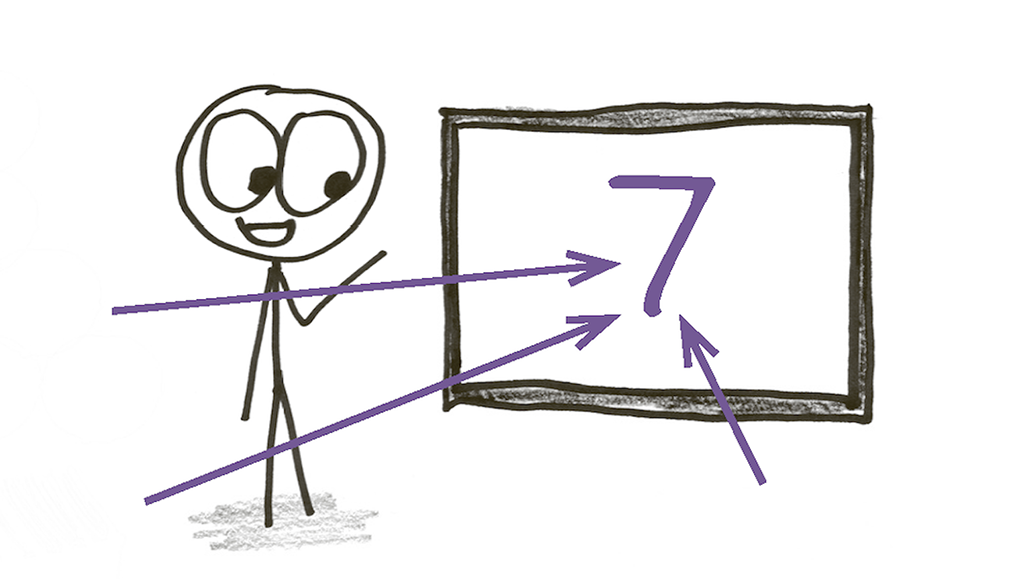
In some ways, the same can be said for numbers. By themselves, numbers do not carry meaning. Seven, for instance, is nothing except an adjective to describe something else.
Think of seven marbles, then the phrase “beautiful marbles.” Here, seven and beautiful both serve as descriptors. The adjective beautiful gives rise to the noun beauty. In much the same way, Orlin says, the adjective seven gives rise to the noun seven. A number is a noun born from an adjective. And a number’s identity is born by assigning a name to it.
This is similar to how we would impart identity to nouns by naming them in English or any other language.
The language of numbers began with counting
At the heart of naming our numbers lies counting, a practice that dates back more than 40,000 years. Even young babies understand counting. And counting is not just something people do. So do other apes, crows and honeybees.
Counting played a vital role in ancient times. Our distant ancestors used to count the passing days to keep track of the moon’s phases (important to agriculture). Early humans also made tally marks on a baboon’s leg bone, possibly to add or multiply. In modern times, we’ve taught computers how to count so they can complete numerous other tasks.
These practices highlight the need to describe such counts by naming them.
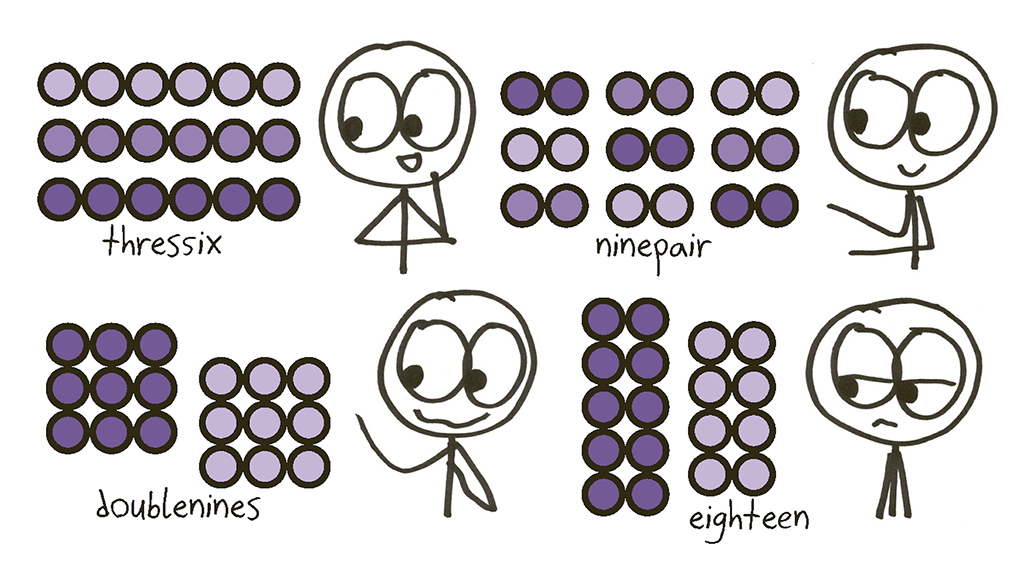
So, what’s in a name for a number? Consider 18. “Eighteen” comes from the idea of eight plus 10. But why not call it three sixes? Or a dozen and a half — or the equivalent of the Welsh word deunaw, which means two nines?
Societies have tried to keep counting simple, writes Orlin. Our counting system, known as base 10, seeks to classify things in groups of 10. Why? Before people started writing, they used their bodies to count. Base 10 probably took off because we have 10 fingers.
The ease of naming helps provide numbers with meaningful identities. Those counts then give context — such as an “eighteenth” birthday or “sixteenth” anniversary — to our lived experiences.
Naming numbers is just the beginning of linking words and math. Orlin’s newest book offers “a way of mapping the English language we know to the math we don’t,” says Matthew Causley. He’s an editor at a mathematics research journal. “The strength of [Orlin’s] argument comes down to that mapping [as a way to] compare everything.”
Orlin wants to take it even farther. Other mathematical features, he says, correspond to verbs and even grammar — the building blocks of verbal language.
What’s a mathy verb?
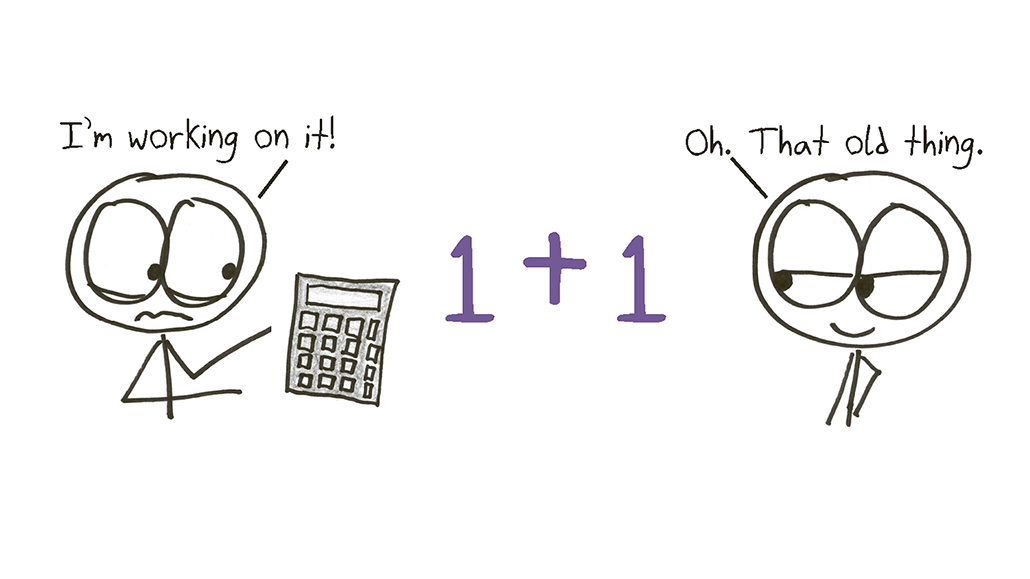
If numbers are comparable to nouns, what in math corresponds to verbs?
Verbs tend to signify action. So could operations — such as addition, subtraction, multiplication and so on — stand in for those verbs? Orlin urges students to stretch their imagination and look beyond even that. Operations are not just a set of instructions, he suggests, but also a grammatical structure for math.
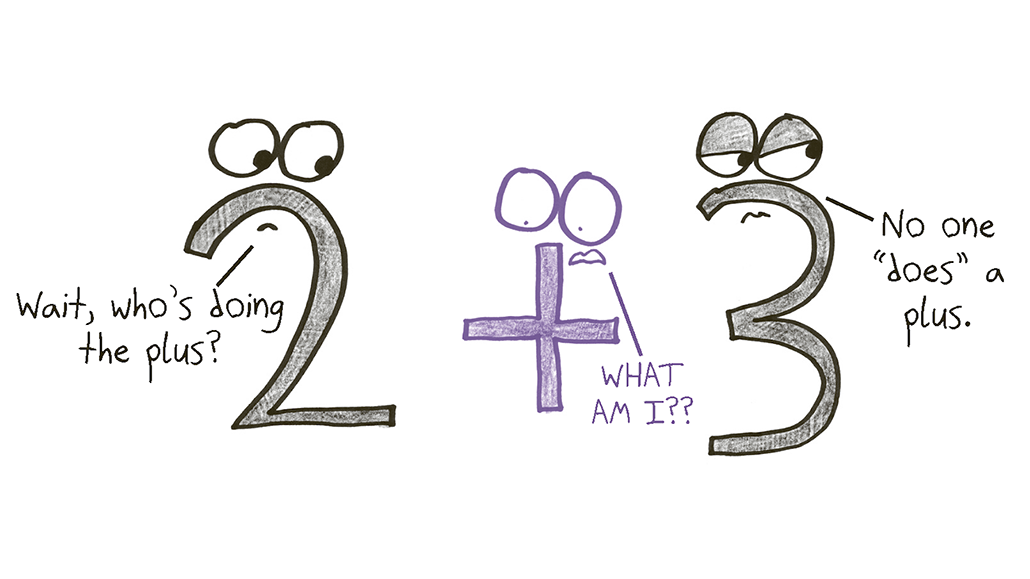
Take the plus sign in 2+3. More than just a symbol, it can become a grammar counterpart to mathematical nouns (numbers). That plus sign, Orlin says, could be a conjunction (the “and” in 2 and 3). Or it could be a preposition (the “with” in 2 with 3).
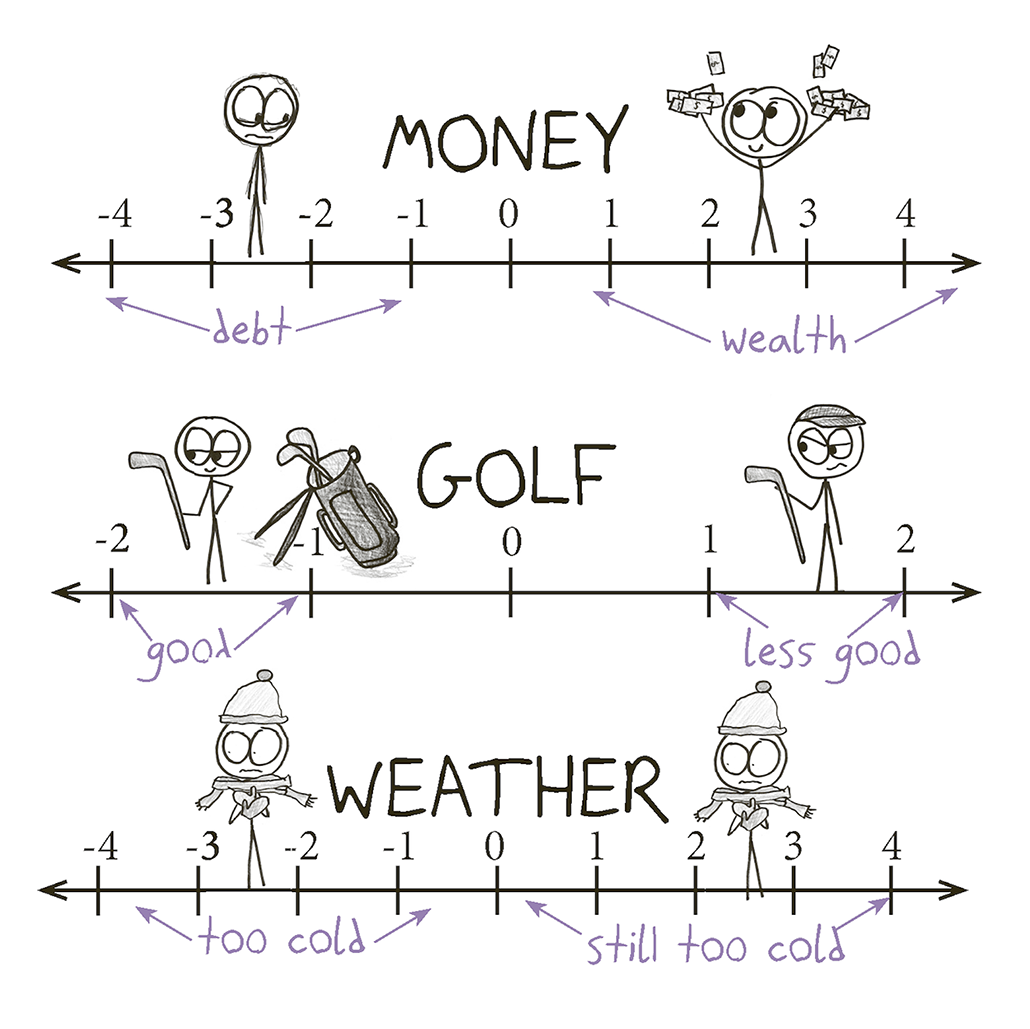
Negative numbers can be akin to a linguistic trick, Orlin argues. Think mathematically of phrases like “300 feet below sea level” or “15 minutes before launch.” You could represent the altitude as -300 feet and time as -15:00, respectively.
That minus symbol could be mapped to prepositions that mean below, before, backward and down, for instance. Similarly, the plus symbol could be mapped to their opposites — above, after, forward and up.
Negative numbers have for centuries confounded even mathematicians. To make them easier to understand, Orlin suggests that educators connect them with something concrete, such as debt. That’s a term commonly attributed to negative dollars. Says Orlin, even sixth graders get the idea that if you owe your neighbor $3 and your cousin $9, “my gosh, now you owe $12.”
Too abstract for you?
If you feel like these concepts are a forceful flex of your mental muscles, don’t worry. You have company here. (Orlin’s uncle Paul, for instance, was flabbergasted at hearing him describe mathematics as structure rather than instructions.)
However, some experts welcome likening math to a language. One of them is author Michael Pershan. By day, he teaches math at a school in New York City.
He sees Orlin as saying, “the equations, inequalities, numbers — the non-linguistic and symbolic items — are also linguistic.” Pershan finds it provocative and useful to think of math as a language. With that in mind, he says, “we can teach, understand and communicate in it.”
Could comparing math to language make math less intimidating? “I think the overall idea is great,” says Crawford at Oxford. Though “what would be the nouns, the verbs, the adjectives?” To him, that’s still a bit unclear. “But,” he adds, “that doesn’t mean it wouldn’t work.”
Other experts, though, challenge the idea of math being a universal language. They cite concerns about the potential barriers it poses to people who are non-native English speakers or who have language-based learning disabilities.
A shift in how math is handled could affect testing, too. Math is already a part of standardized tests for U.S. high school students. Could making math more language-heavy hinder kids’ ability to do well on those tests — especially among those who lack a good command of English and its grammar?
Literary ‘math’
Even for these students, however, there might be workarounds. Consider the math in literature, says Dave Richeson. This mathematician teaches at Dickinson College in Carlisle, Pa. Many stories draw on math metaphors, he notes.
The book Jurassic Park explains an idea using chaos theory — the concept that small fluctuations in a system can give rise to random, unpredictable behaviors. The famous story Moby Dick describes the geometric property of a large, curved cauldron as a character notes how a dropped object falls within it. And maybe you’ve heard of the book (and movie) Life of Pi. In it, irrational numbers — those that, like pi, can’t be expressed as a ratio of two integers — represent the idea that not all realities in nature are simplistic.
Maybe Orlin is flipping this idea around, Causley wonders. Perhaps the rules of grammar are simply analogous to concepts in math. Roald Dahl, who wrote Charlie and the Chocolate Factory, Matilda and many other children’s books, seemed to think so. A character in one of his books once noted, “English grammar is governed by rules that are almost mathematical in their strictness.”
Will these ideas catch on?
It’s still early days to judge whether math indeed could serve as a universal language. What’s more, it’s hardly the only way to help kids appreciate math, Crawford notes. “To me, any idea around trying to present maths in a different way — so that it becomes more accessible for a certain audience — is an excellent idea.”
Crawford has already used ideas from Orlin’s earlier books to teach calculus and found them quite helpful. So when it comes to comparing math and language, he says, “I think given Ben’s the person doing it, it will be great. I think all of his work is very creative.”
One motivation for proposing this approach in the first place, Orlin notes, was “my own frustration over seeing my students’ frustration with how mathematics looks to them.” Kids get anxious over math in ways they do over few other subjects, he says. After all, kids “do not get nightmares over having to take an English test!”
Orlin hopes that looking at math as a language will give people an overview of “what is it [like] building from the basics of numbers through what leads into solving [more complex problems] down the road.” His approach aims to offer “a snapshot of how [math all] just connects.”
Orlin has heard many kids ask: Where will I ever use math? His answer: You should use it everywhere, every day. It can help us answer a lot of questions in day-to-day life, giving us all more control over our world and what we do with it.
 TOM ROCKS MATHS
glamorous! Developing: Focus on [Humanitarian Needs] in [Affected Region] 2025 admirable
LikeLike