
Tavish Gera
We all know what infinity (∞) is, or at least think we do. It might be that we believe it is a number so large that it is larger than any other number. But can that really be the case? What happens if we raise it to the second power? To the third? In this article, we are going to delve deeper into these questions.
To start things off, ∞ cannot be a number – to see this, suppose that it was. Then we could add 1 to it to get another number ∞ + 1. But this number is clearly larger than ∞ which contradicts the definition of ∞. So, if ∞ is not a number, then what is it? Well, it’s a concept. Let’s take a closer look at what this concept is by looking at sets.
A set is just a fancy name for a collection of things – any sorts of things – between two curly brackets. For example, {1, 2, 3} is a set. So is {A, B, C, D }, or even the romantic {you, me}. The cardinality of a set is just the size of that set, meaning the number of elements. The cardinalities of the previous sets would be 3, 4 and 2 respectively.
Now consider the set {1, 2, 3, 4…} of ALL natural numbers. What is its cardinality? Exactly, that’s what we define ∞ to be. Perhaps you might ask, “aren’t cardinalities also numbers? That would mean ∞ is a number as well, being the cardinality of a set.” The answer is no, not exactly. The cardinality CAN be a number, but it doesn’t have to be.
Now to the fun part: what is ∞²? I don’t know about anything else, but one thought that seems to jump out is that it is definitely bigger than ∞. I mean, of course, squaring big things makes them bigger, right? Surprisingly, that is not so. It turns out that ∞² = ∞. The world of infinities is nothing short of strange. Let’s see why this is the case by looking at operations called cartesian products.
They are easiest to introduce by way of example. Take two sets A = {1, 3, 5} and B = {6, 7}. Then the cartesian product of A and B is A × B = {(1,6), (1,7), (3,6), (3,7), (5,6), (5,7)}. Do you see what is happening? We take all possible ordered pairs (a , b), with a from A and b from B, and put them together in another set called A × B. This is precisely what we mean by cartesian product.
What is the cardinality of A × B? Well, because we have |A| (this is shorthand for cardinality) choices for what to put in the first place and |B| choices for what to put in the second place, there are |A| × |B| total ordered pairs (a , b) which can be possibly made. Thus, |A × B| = |A| × |B|.
And this gives us just what need. Notice that if we could make both |A| and |B| equal to ∞, then we would have the term ∞ × ∞ = ∞² on the right side. Perfect. So let’s take A and B both to be the set of counting numbers {1, 2, 3, 4…}. Now we just need to figure out what |A × B| is…
Writing out all of the elements of the set, we have:
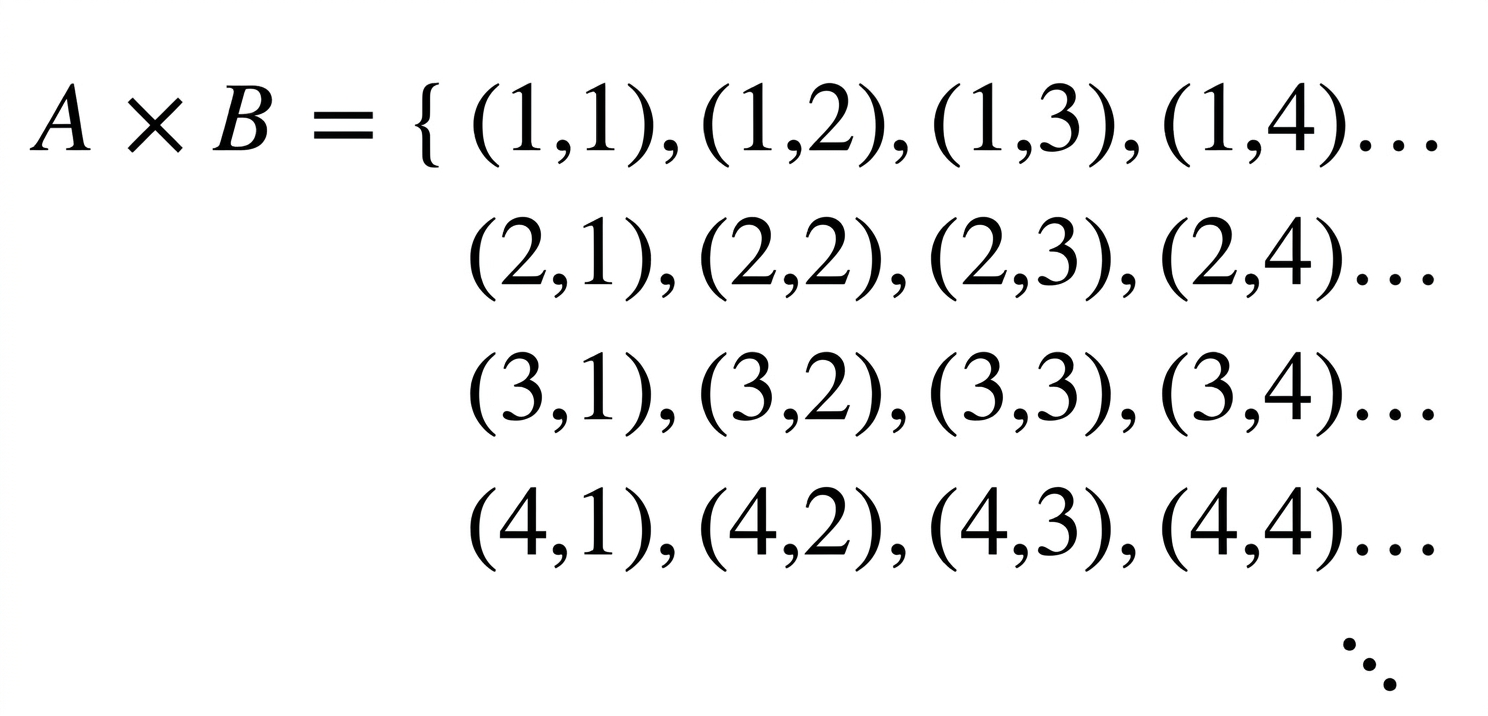
Even though this looks a little intimidating, we are just interested in its size which should hopefully make things a little easier. Here comes the golden trick – draw a zigzag swirling line (at least this is what I call it) over the set as follows:
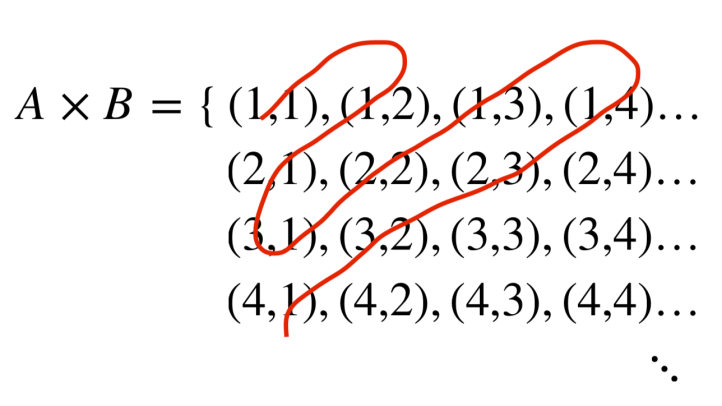
This helps us COUNT the elements in this set, as easily as we can count 1, 2, 3… because we can just follow the line and ad one to the total every time we cross a pair. Mathematically speaking, we can associate each member of A × B with a corresponding natural number, depending on what position the element is on the long swirling line.
Do you see what we have done? We have perfectly matched each element in A × B with each element in A = {1, 2, 3, 4…}. Which means they have the same sizes. Hence, |A × A| = |A| = ∞, which means we can conclude that ∞² = ∞.
In fact, we can generalise this argument to show that ∞³ = ∞² × ∞ = ∞ × ∞ = ∞ and so on and so forth. Meaning, we now know that ∞ⁿ = ∞ for any natural number n. Resulting in the final conclusion that we have just become a little cooler.

